

Imagine walking into a job interview in 2026 and realizing that half the candidates can already automate their entire onboarding process using Artificial Intelligence is a technology that enables machines to perform tasks requiring human-like intelligence, such as learning, reasoning, and problem-solving.. It sounds like science fiction, but it’s Tuesday. The question isn’t whether you should learn AI anymore; it’s how fast you can start before your industry shifts beneath your feet.
The Reality Check: Why AI Skills Are No Longer Optional
We used to think AI was just for engineers sitting in Silicon Valley offices writing complex code. That era is over. Today, Generative AI is a subset of AI capable of creating new content, including text, images, audio, and code, based on input prompts. handles customer service chats, designs marketing graphics, writes legal briefs, and even diagnoses medical conditions. If you’re not engaging with these tools, you aren’t just falling behind-you’re becoming irrelevant.
Consider the data from recent workforce studies. By 2025, nearly 70% of companies reported integrating some form of AI into their daily operations. Fast forward to today, and that number has likely crossed 90%. This isn’t about replacing humans entirely; it’s about augmenting human capability. People who understand how to direct Large Language Models (LLMs) are advanced AI systems trained on vast amounts of text data to understand and generate human language. get more done in an hour than others do in a day. The gap between those who know AI and those who don’t is widening rapidly.
Who Needs to Learn AI? (Spoiler: It’s You)
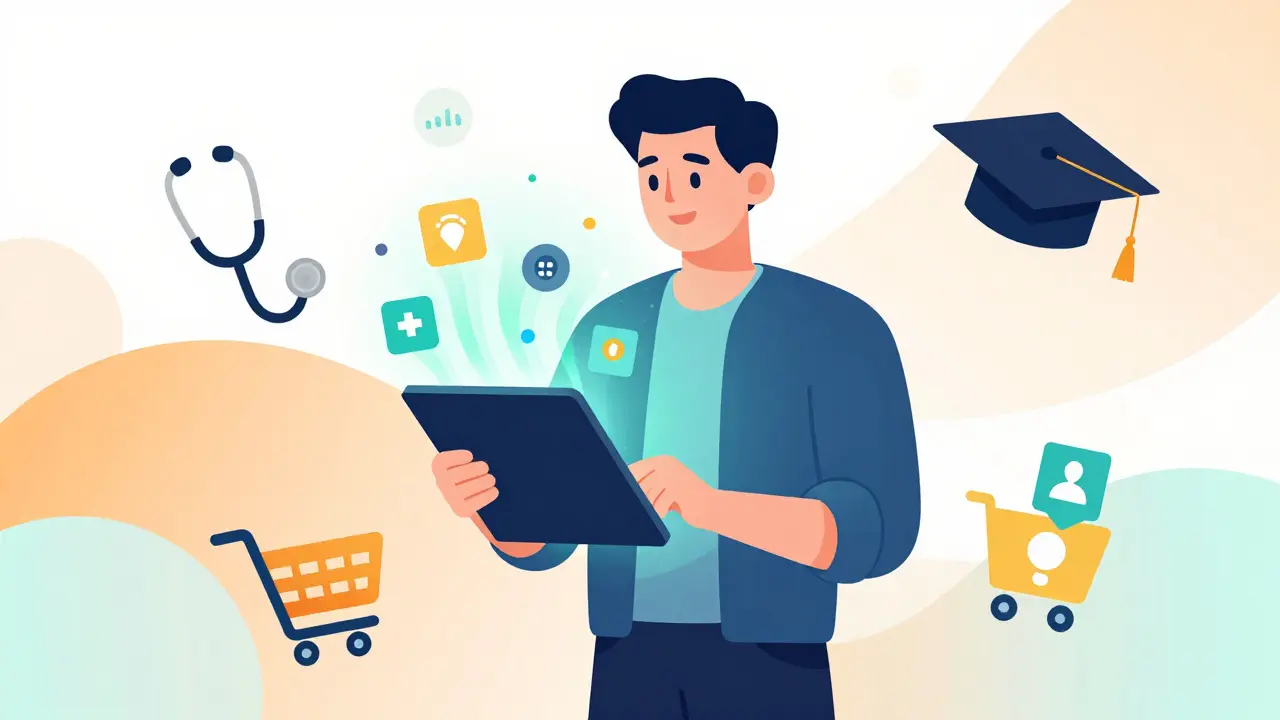
You might be thinking, “I’m a graphic designer, not a coder.” or “I manage sales teams, I don’t write algorithms.” Here is the truth: every role is changing. Let’s break down what this means for different professions.
- Marketers: You no longer need to spend weeks brainstorming campaign ideas. Tools powered by Predictive Analytics is the use of historical data and statistical algorithms to forecast future outcomes. can tell you exactly which audience segments will convert. Your job shifts from creation to strategy and ethical oversight.
- Healthcare Professionals: Doctors are now using AI to interpret X-rays faster and more accurately than ever before. Learning to trust and verify these diagnostic aids saves lives. Ignorance here isn’t just inconvenient; it’s dangerous.
- Students: If you are still memorizing facts for exams, you are wasting time. AI can retrieve information instantly. Your value lies in critical thinking, synthesis, and asking the right questions. Schools are beginning to reflect this, focusing less on rote learning and more on digital literacy.
- Small Business Owners: You can’t afford a full-time data scientist. But you can use affordable AI plugins to analyze your inventory trends, automate email responses, and personalize customer experiences. This levels the playing field against larger corporations.
The common thread? AI literacy is the new basic literacy. Just as reading and writing were once specialized skills that became mandatory, understanding how to interact with intelligent systems is now a baseline requirement for professional survival.
How to Start Learning AI Without a Computer Science Degree
The barrier to entry has dropped significantly. You do not need to understand the deep mathematics behind neural networks to be effective. You need to understand how to use the tools. Here is a practical roadmap to getting started in 2026.
- Master Prompt Engineering: This is the skill of communicating effectively with AI models. It involves being specific, providing context, and iterating. For example, instead of asking an AI to “write a blog post,” ask it to “Write a 500-word blog post for small business owners about tax deductions, using a friendly tone and bullet points.” Practice this daily.
- Explore No-Code Platforms: Platforms like Zapier is an automation platform that connects different apps and services to automate workflows without coding. or Make is a visual automation tool that allows users to create complex workflows by connecting various APIs and applications. allow you to build AI-powered automations without writing a single line of code. Connect your CRM to an AI chatbot and watch your response times drop.
- Understand Data Basics: AI runs on data. You don’t need to be a statistician, but you must understand what clean data looks like. Garbage in, garbage out. Learn how to organize your spreadsheets and databases so that AI tools can actually read them.
- Take Micro-Courses: Forget four-year degrees for now. Look for short, focused courses on platforms like Coursera or edX that cover specific topics like “AI for Business” or “Ethics in Machine Learning.” These provide immediate, applicable knowledge.
The goal is not to become an AI researcher overnight. The goal is to become an AI-augmented professional. Start small. Automate one tedious task this week. Then another. Build momentum.
The Risks: What Happens When You Ignore AI?
Let’s talk about the downside. Ignoring AI doesn’t mean you’ll stay safe; it means you’ll be vulnerable. First, there is the risk of obsolescence. Roles that rely heavily on repetitive cognitive tasks-data entry, basic copywriting, routine analysis-are being automated at an unprecedented rate. If your only value proposition is speed at typing or calculating, AI will replace you.
Second, there is the risk of poor decision-making. As AI becomes embedded in hiring, lending, and healthcare decisions, bias within these systems can have real-world consequences. If you don’t understand how AI works, you cannot audit it for fairness. You become a passive consumer of potentially flawed outputs. In a professional setting, this lack of oversight can lead to costly errors and reputational damage.
Finally, there is the opportunity cost. Every hour you spend resisting AI is an hour you could spend leveraging it to innovate. While you are debating whether AI is a threat, your competitors are using it to launch products, engage customers, and optimize supply chains. They are winning not because they are smarter, but because they are faster.

Ethical Considerations: Using AI Responsibly
With great power comes great responsibility. As you integrate AI into your life and work, you must navigate ethical gray areas. One major issue is intellectual property. Who owns the content generated by AI? Currently, laws are evolving, but generally, AI-generated content cannot be copyrighted in many jurisdictions. This means you need to add significant human creative input to protect your work.
Another critical area is privacy. Be cautious about feeding sensitive personal or company data into public AI models. Many platforms use input data to train their models, which could inadvertently expose confidential information. Always check the privacy policy of any AI tool you use. For highly sensitive tasks, consider using enterprise-grade solutions that offer data isolation.
Bias is another persistent challenge. AI models learn from historical data, which often contains societal biases. An AI hiring tool might favor certain demographics if trained on biased past hiring data. As a user, you must remain vigilant. Question the outputs. Diverse perspectives are essential when deploying AI systems to ensure they serve all users fairly.
| Skill Area | Traditional Approach | AI-Augmented Approach | Efficiency Gain |
|---|---|---|---|
| Content Creation | Manual writing and editing | AI drafting + human refinement | 3x faster |
| Data Analysis | Manual spreadsheet formulas | Natural language queries to AI | 10x faster |
| Coding | Writing code from scratch | AI code generation + debugging | 4x faster |
| Customer Support | Human agents handling all tickets | AI bots handling 80% of queries | 90% reduction in wait time |
The Future Outlook: Where Do We Go From Here?
We are standing at the precipice of a new era. The next few years will see AI moving from generative tasks to agentic behaviors. This means AI won’t just create content; it will take action. Imagine an AI assistant that not only writes your travel itinerary but also books the flights, reserves the hotels, and adjusts your calendar automatically. This shift requires even deeper understanding and trust.
Education systems are slowly adapting, but individuals must take charge of their own learning. Lifelong learning is no longer a buzzword; it is a necessity. The half-life of skills is shrinking. What you learned five years ago may already be outdated. Embrace curiosity. Stay updated on the latest developments in Machine Learning is a subset of AI that focuses on building systems that learn from and make decisions based on data. and its applications.
Remember, AI is a tool, not a master. Its value depends entirely on how well you wield it. Those who approach AI with skepticism and fear will find themselves left behind. Those who approach it with curiosity and caution will thrive. The choice is yours.
Do I need to know how to code to learn AI?
No, you do not need to be a programmer to benefit from AI. While coding helps you build custom solutions, most professionals can leverage AI through no-code platforms and prompt engineering. Understanding how to communicate with AI models is more valuable for most roles than knowing Python syntax.
Will AI replace my job?
AI is unlikely to replace entire jobs, but it will replace tasks within jobs. Roles that involve repetitive, predictable tasks are most at risk. However, jobs requiring creativity, emotional intelligence, strategic thinking, and complex problem-solving are safer. The key is to augment your role with AI rather than compete against it.
What is the best way to start learning AI in 2026?
Start by identifying one repetitive task in your workflow and finding an AI tool to automate it. Experiment with popular Large Language Models to understand their capabilities and limitations. Take online courses focused on AI literacy for your specific industry. Focus on practical application rather than theoretical depth initially.
Is it safe to use AI tools for work?
Safety depends on the tool and the data. Avoid uploading sensitive personal or proprietary information to public AI models unless they guarantee data privacy. Use enterprise-grade solutions for confidential work. Always review AI outputs for accuracy and bias before publishing or making decisions based on them.
How does AI affect career growth?
Proficiency in AI is becoming a key differentiator in the job market. Employees who can effectively use AI tools are seen as more productive and innovative. Learning AI opens doors to new roles, increases earning potential, and provides resilience against automation. It is one of the highest-return investments you can make in your career.