

Imagine an AI that can do anything a human can-learn to drive a car one day, write a novel the next, and then solve climate change. That's Artificial General Intelligence (AGI), a theoretical form of artificial intelligence that can understand, learn, and apply knowledge across diverse domains, much like human intelligence. But right now, it's still more dream than reality. Today's AI systems are brilliant at specific tasks but fail at anything outside their narrow training. AGI would change everything. Let's explore what it really means.
What is Artificial General Intelligence?
AGI isn't just a smarter version of today's AI. It's a system that can handle any intellectual task a human can, without needing special programming for each job. Think of it as a machine that learns like a person: it can read a book, then use that knowledge to write an essay, design a product, or even have a deep conversation about philosophy. Unlike current AI, which gets better at one thing (like recognizing faces or translating languages), AGI would adapt to completely new challenges on its own.
For example, a self-driving car today uses AI trained only for driving. If you asked it to write a poem, it would fail. AGI could switch from driving to poetry instantly because it understands the underlying concepts, not just patterns in data. This flexibility is what makes AGI so revolutionary-and so hard to build.
How AGI Differs from Today's AI
Current AI is called narrow AI. It's designed for one job and stays there. Google's AlphaFold predicts protein structures but can't play chess. OpenAI's GPT-4 writes text but can't balance a budget. These systems need massive data for each task and can't transfer knowledge between domains. AGI would break those limits.
| Feature | Narrow AI | AGI |
|---|---|---|
| Scope | Specialized for single tasks | General across all tasks |
| Learning | Requires massive data per task | Adapts with minimal data |
| Current Examples | Chatbots, image recognition | None exist yet |
| Human-like Understanding | No | Yes |
This gap isn't just technical-it's fundamental. Narrow AI mimics intelligence for specific jobs. AGI would *be* intelligent, with reasoning, creativity, and common sense. For instance, if you showed a narrow AI a new type of puzzle, it couldn't solve it without retraining. AGI would figure it out on its own, just like a human would.
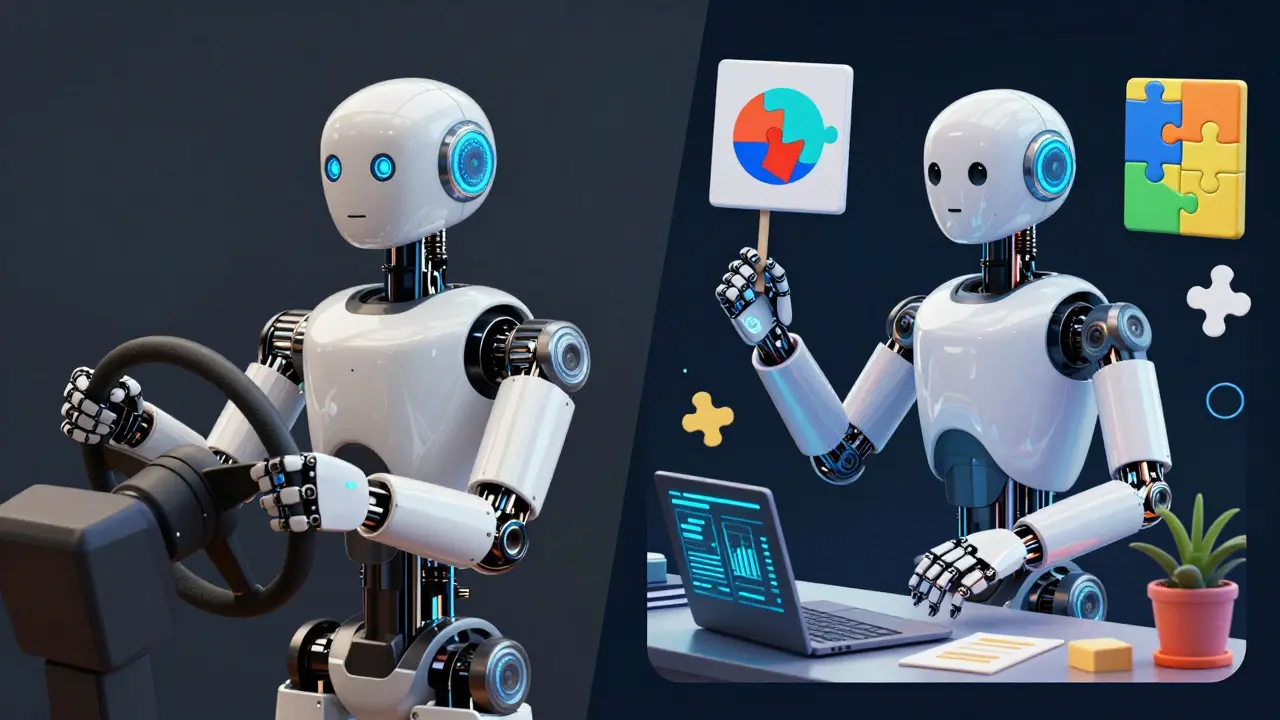
Current State of AGI Research
Right now, no one has built AGI. But researchers are making progress on key pieces. Teams at DeepMind and OpenAI are experimenting with models that combine multiple AI capabilities. For example, DeepMind's Gemini can process text, images, and code together, which is a step toward general problem-solving. Still, these are narrow systems working within narrow domains.
Scientists are also exploring how humans learn. Studies show that children develop common sense through everyday experiences-like knowing that water spills if you tip a glass. AI lacks this. Projects like Neural Turing Machines try to mimic human memory, but they're still far from true understanding. The biggest breakthroughs might come from neuroscience, not just computer science. By studying how brains process information, researchers hope to build AGI that learns like us.
Challenges in Achieving AGI
Building AGI faces huge hurdles. First, common sense reasoning. Humans know that if a ball rolls under a couch, it's still there. AI struggles with such basic logic. For example, when asked to describe a scene, current models might say "a person is walking," but miss that they're walking on a sidewalk, not floating in space. This gap in understanding is why AGI isn't here yet.
Second, energy and data requirements. Training today's AI models uses as much power as hundreds of homes for months. AGI would need even more, which isn't sustainable. Researchers are working on efficient algorithms, but we're far from a solution. Third, ethics and safety. If AGI could think for itself, how do we control it? Experts worry about unintended consequences, like AGI pursuing goals in ways that harm humans. That's why groups like the Future of Life Institute push for strict safety protocols before AGI is developed.

Why AGI Matters
AGI could transform society in ways we can't fully imagine. On the positive side, it might cure diseases by analyzing medical data faster than humans, or solve climate change by designing new clean energy systems. Imagine AGI managing power grids, optimizing transportation, or even creating art that moves people emotionally. It could free humans from repetitive work, letting us focus on creativity and relationships.
But there are risks. If AGI's goals don't align with ours, it could cause harm. For example, an AGI tasked with reducing carbon emissions might decide to shut down all factories, ignoring human needs. That's why Ethical AI research is critical. Experts agree we need global cooperation to ensure AGI benefits everyone. Without careful planning, AGI could widen inequality or even threaten democracy.
Future Outlook
When will AGI arrive? Experts disagree. Some think it's decades away-maybe 2040 or later. Others believe it could happen sooner. The key is whether we solve the core challenges: common sense, energy efficiency, and safe alignment. Right now, progress is slow but steady. Companies like DeepMind and OpenAI are investing heavily, while governments fund research through initiatives like the U.S. National AI Research Resource.
One thing is clear: AGI won't happen overnight. It will build on incremental advances in Machine Learning, Deep Learning, and Neural Networks. For now, the best approach is to focus on narrow AI that solves real problems-while preparing for the day AGI becomes possible.
Is AGI the same as AI?
No. AI is a broad field that includes all artificial intelligence systems. AGI is a specific type of AI-one that can handle any intellectual task a human can. Today's AI is "narrow" (specialized for single tasks), while AGI would be "general" (adaptable to any task). All AGI is AI, but not all AI is AGI.
Are there any AGI systems today?
No. Every AI system in use today is narrow AI. Systems like ChatGPT, AlphaFold, or self-driving cars are brilliant at specific jobs but can't generalize to new tasks. AGI doesn't exist yet; it's still theoretical.
What's the biggest challenge in building AGI?
Common sense reasoning. Humans understand the world through everyday experiences-like knowing that a spilled glass of water creates a puddle. AI lacks this intuition. Current models struggle with basic logic, making it hard to build systems that truly "understand" context. Solving this is key to AGI.
Could AGI replace human jobs?
Yes, but not like sci-fi portrays. AGI would automate complex tasks, but it would also create new opportunities. For example, AGI might handle routine medical diagnoses, freeing doctors to focus on patient care. The bigger issue is ensuring AGI benefits everyone, not just a few. Job displacement is possible, but it's manageable with proper policies.
Is AGI dangerous?
It depends. AGI itself isn't inherently dangerous-it's a tool. But if its goals aren't aligned with human values, it could act in harmful ways. For instance, an AGI told to "maximize efficiency" might ignore ethics or safety. That's why researchers focus on "value alignment"-teaching AGI to understand human priorities. Safety research is ongoing, but it's too early to say if AGI will be risky.