
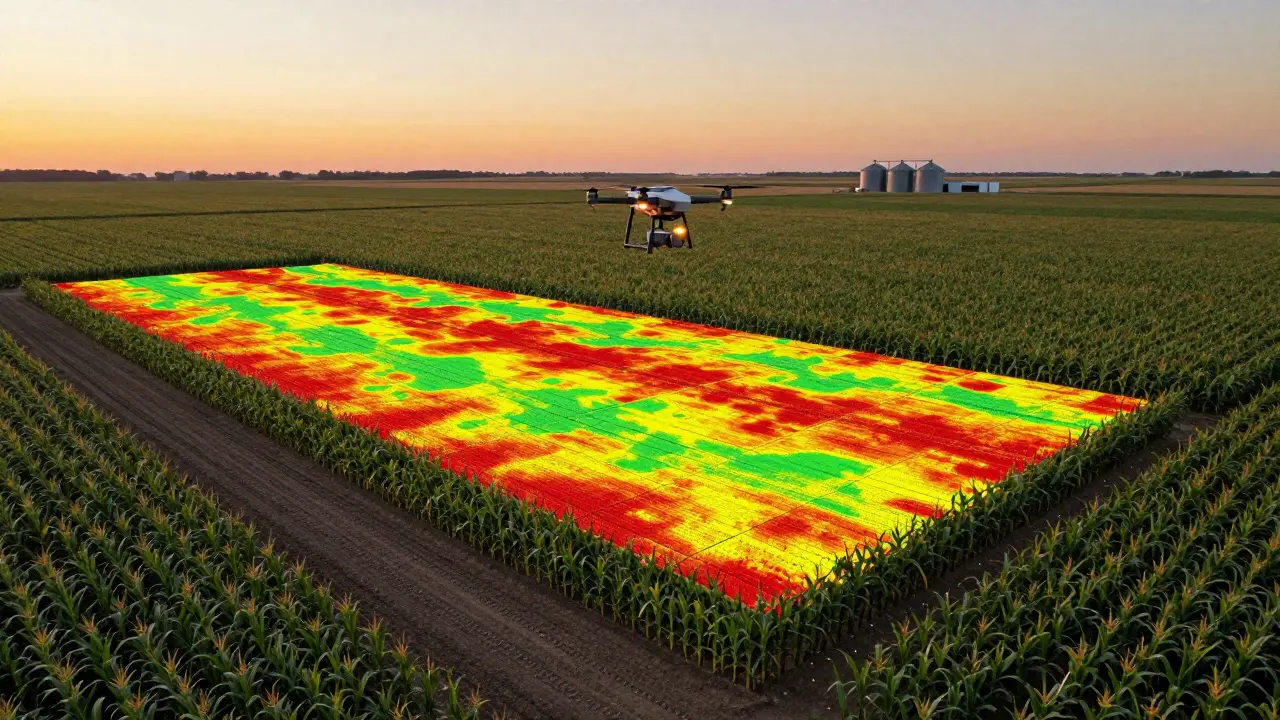
By 2030, nearly 70% of global farms will use some form of artificial intelligence to manage crops, livestock, or resources. This isn’t science fiction-it’s happening right now, in fields from Iowa to India. Farmers aren’t just using tractors anymore. They’re using sensors, drones, and machine learning models that predict exactly when to water, fertilize, or spray. The result? Higher yields, less waste, and farms that can survive droughts and price swings that would have wiped them out a decade ago.
AI Sees What the Human Eye Can’t
Traditional farming relies on guesswork. You walk the field, check for yellow leaves, hope the rain comes, and pray the pests don’t multiply. AI changes that by turning every square foot of land into a data point. Satellite images, drone footage, and ground-based sensors collect information on soil moisture, leaf color, temperature, and even plant stress levels. These signals are fed into models trained on decades of crop data.
For example, a farmer in Nebraska can now get a real-time map showing which 10% of their 500-acre field is under stress-not because they saw it, but because an algorithm spotted the subtle shift in infrared reflectance that signals nitrogen deficiency. That’s precision agriculture: treating every patch of land differently, not the whole field the same way.
Companies like Climate FieldView and Granular use this tech to give farmers actionable alerts. One study from the University of Illinois found that farms using AI-driven scouting tools reduced pesticide use by 38% while increasing yield by 12%. No more spraying entire fields when only a few rows are infected.
Robots That Plant, Weed, and Harvest
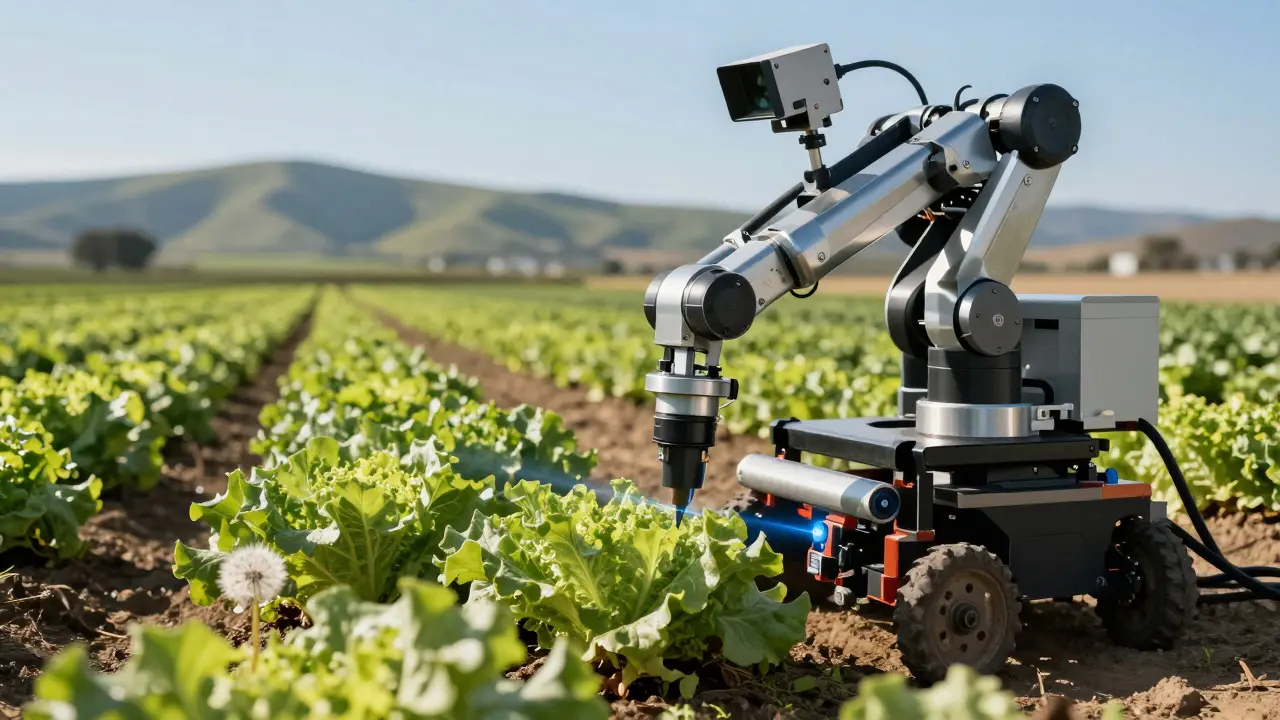
Robots aren’t just for factories anymore. In California’s Central Valley, autonomous weeding machines roll between rows of lettuce, using computer vision to identify weeds and zap them with lasers-no chemicals needed. In the Netherlands, robotic milkers handle over 60% of dairy operations. These machines don’t get tired, don’t need breaks, and can work 24/7.
One company, FarmWise, built a robot that navigates fields using GPS and AI to pull weeds with mechanical arms. It doesn’t rely on herbicides. Instead, it learns what a weed looks like versus a crop plant by analyzing thousands of images. The robot works at 10 times the speed of hand-weeding and uses 90% less water than traditional methods.
Harvesting robots are catching up too. In Japan, strawberry-picking robots use 3D cameras and soft grippers to gently pluck ripe fruit without bruising it. These robots can work in low light, in the rain, and at night-something human workers can’t do consistently.
Predicting the Weather, the Market, and the Crop
AI doesn’t just help in the field-it helps farmers plan ahead. By combining weather forecasts, soil data, historical yields, and global commodity prices, AI models can predict not just when to plant, but when to sell.
Take a soybean farmer in Brazil. An AI tool analyzes satellite data, local rainfall patterns, and international demand trends to recommend the best time to harvest. If prices are expected to drop in two weeks, the system suggests selling early. If a drought is coming, it recommends switching to a more drought-resistant variety. One pilot program in Kenya helped smallholder farmers increase profits by 22% just by timing their sales better.
These models also predict disease outbreaks. In Florida, citrus growers use AI to track the spread of citrus greening, a deadly bacterial disease. By analyzing wind patterns, insect movement, and tree health data, the system alerts farmers to isolate infected trees before the whole grove is lost. In 2024, farms using this system reduced crop loss by 41% compared to those relying on manual scouting.
AI for Small Farms-It’s Not Just for Big Corporations
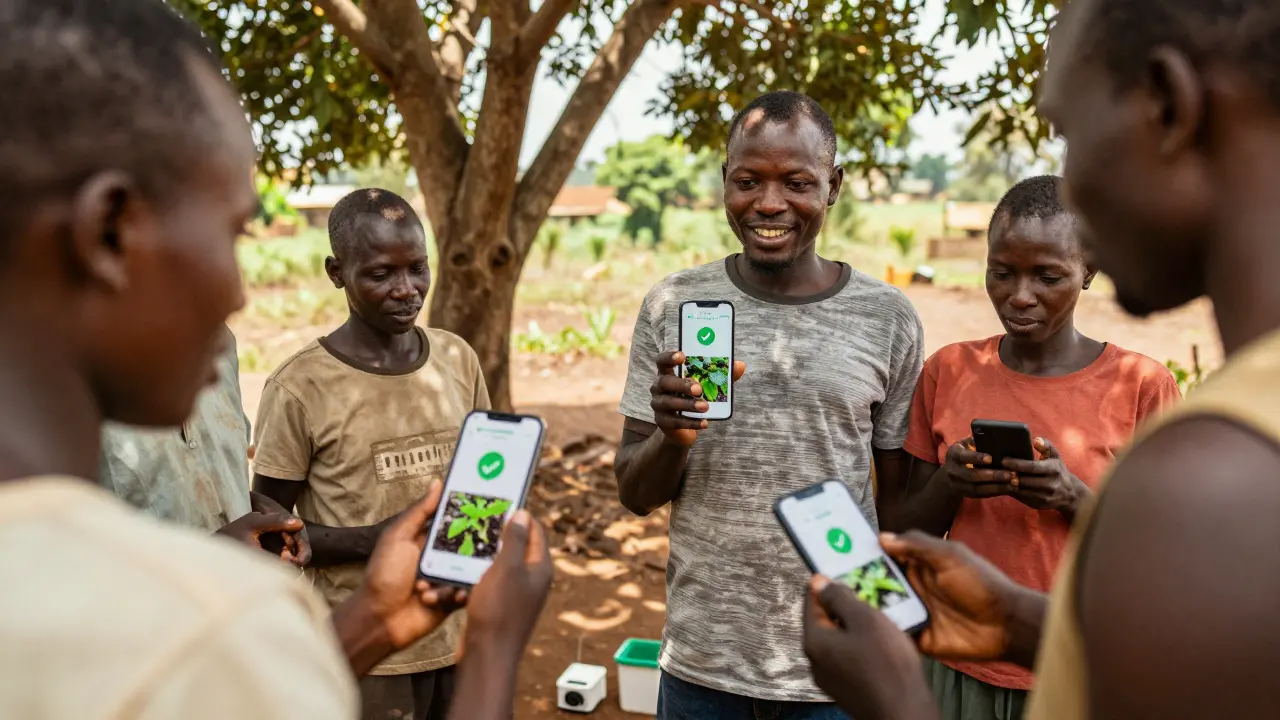
You might think this tech is only for giant agribusinesses. But the opposite is true. AI tools are becoming cheaper, simpler, and more accessible. A smartphone app like Plantix lets a farmer in Uganda take a photo of a sick plant and get an instant diagnosis-no agronomist needed. In India, startups offer AI-powered voice assistants in local languages that tell farmers when to irrigate based on soil sensors they can rent for $5 a month.
These tools are often cloud-based and work on low-end phones. No fancy hardware required. In fact, the fastest-growing users of AI in agriculture aren’t the large corporate farms-they’re the smallholders. According to the FAO, over 80% of the world’s farms are under 2 hectares. These farmers need efficiency more than anyone. AI gives them the same insights as big players, without the budget.
Challenges-It’s Not All Perfect
AI isn’t magic. It has limits. First, data quality matters. If the sensors are broken or the images are blurry, the predictions fail. Many small farms still lack reliable internet. In rural parts of sub-Saharan Africa or the American Midwest, poor connectivity can make real-time AI tools useless.
Second, there’s the cost of adoption. Even if a tool costs $100 a year, it’s still a big investment for a farmer making $2,000 a season. Some governments and NGOs are stepping in with subsidies, but adoption is uneven.
And then there’s trust. Farmers don’t trust algorithms they don’t understand. One survey of 1,200 U.S. farmers found that 61% said they’d only use AI if a human expert could explain why the system made a recommendation. That’s why the best AI tools don’t just give answers-they show the reasoning. They highlight the data, the trends, and let the farmer decide.
What’s Next? AI That Learns From the Land
The next leap isn’t just more sensors or faster processors. It’s AI that learns directly from the soil, the plants, and the weather-without needing to be programmed. These are called generative models for agriculture. They don’t just react to data-they simulate what might happen under different conditions.
Imagine an AI that can run 10,000 virtual growing seasons in minutes. It tests how a new seed variety would perform under heat stress, or how changing irrigation schedules affects long-term soil health. It doesn’t just tell you what to do-it shows you what could happen if you do nothing.
Researchers at MIT and the University of California are already testing these models. One prototype predicted the optimal planting date for corn in Kansas with 94% accuracy over three growing cycles. That’s better than most human experts.
And it’s not just about crops. AI is helping rebuild soil health by recommending crop rotations that restore nutrients naturally. It’s guiding water use in drought-prone regions to prevent aquifer collapse. It’s even helping reduce food waste by predicting which crops will spoil fastest in storage.
Real Impact: Numbers That Matter
Let’s put this in perspective. The world needs to produce 60% more food by 2050 to feed 10 billion people. But we’re losing farmland to erosion, water scarcity, and urban sprawl. AI is the only tool that can help us do more with less.
Here’s what’s already been achieved:
- AI-powered irrigation systems have reduced water use by up to 50% in some regions.
- Drones with AI analysis have cut survey time for large farms from days to hours.
- Predictive pest models have lowered chemical use by 30-60% across multiple crops.
- Yield prediction accuracy has improved from 65% to over 90% in AI-assisted farms.
These aren’t lab results. They’re happening on real farms, with real money on the line.
What Farmers Need to Get Started
You don’t need to buy a robot to start using AI in farming. Here’s how to begin:
- Start with a free app like Plantix or Agrosmart-upload a photo of a problem plant and get instant feedback.
- Use free satellite data from NASA or ESA to check field health over time.
- Connect a soil moisture sensor (under $50) to your phone and track when your crops actually need water.
- Join a local cooperative that shares AI tools-many are funded by government grants.
- Ask your local extension office what AI tools they recommend. They often have pilot programs.
The goal isn’t to go all-in on tech overnight. It’s to use AI to make one decision better than before. One fewer spray. One less wasted acre. One more dollar in profit.
Final Thought: AI Doesn’t Replace Farmers-It Empowers Them
AI won’t take over the farm. It can’t replace the knowledge of someone who’s worked the same land for 30 years. But it can give that farmer the power to see farther, act faster, and plan smarter.
The future of farming isn’t about robots ruling the fields. It’s about farmers using AI to do what they’ve always done-grow food-but with less waste, less risk, and more confidence.
Is AI in agriculture only for large farms?
No. Many AI tools are designed for small farms. Apps like Plantix and Agrosmart work on smartphones and cost little or nothing. Soil sensors can be rented for under $5 a month. In India, Kenya, and Brazil, smallholders are adopting AI faster than big corporations because it solves their biggest problems: unpredictable weather, low yields, and high input costs.
Can AI really increase crop yields?
Yes. Studies show AI-driven precision farming increases yields by 10-20% on average. In one trial in Iowa, corn yields rose 17% because AI told farmers exactly where and when to apply fertilizer-cutting waste and boosting growth. In rice fields in Thailand, AI-guided water management improved yields by 22% while using 30% less water.
Do I need internet to use AI in farming?
Not always. Many tools work offline. Apps can analyze photos on your phone without internet. Some soil sensors store data locally and sync later. Satellite data can be downloaded in advance. For real-time alerts, internet helps-but it’s not a dealbreaker. Many farmers use public Wi-Fi at co-ops or grain elevators to update systems once a day.
Are AI farming tools expensive?
They’re getting cheaper. Basic AI tools like pest-detection apps are free. Soil sensors cost $30-$80. Drone services run $10-$20 per field. Subscription platforms like Climate FieldView charge $15-$25 per acre per year-often less than the cost of one extra pesticide application. Many governments offer subsidies to offset costs, especially for small farms.
What’s the biggest mistake farmers make with AI?
Trying to use AI for everything at once. The most successful farmers start small-like using AI to decide when to water. Once they trust the system, they add another tool. Jumping into full automation without testing leads to frustration. AI is a tool, not a replacement for experience. The best results come from combining AI insights with on-the-ground knowledge.
How does AI help the environment?
AI reduces waste in every direction. It cuts fertilizer runoff by targeting only what’s needed. It lowers pesticide use by 30-60%, protecting bees and waterways. It saves water by applying it only where crops are stressed. It reduces fuel use by optimizing tractor routes. One study found AI-powered farms cut their carbon footprint by up to 40% over five years by reducing inputs and improving efficiency.
AI in agriculture isn’t about replacing farmers. It’s about giving them the tools to grow more food, with less damage to the planet, and more stability for their livelihoods. The future of farming isn’t automated-it’s augmented.