
Python isn't just popular for AI-it's the default language for building intelligent systems. If you're starting out in artificial intelligence, or even if you've been tinkering with models for a while, the truth is simple: Python makes AI work. Not because it's the most powerful language, but because it's the most practical one. You don't need to write a single line of C++ to train a neural network that recognizes faces. You don't need to build a custom data pipeline from scratch. Python gives you the tools, the libraries, and the community to get results fast.
Why Python? It's Not Magic, It's Mechanics
Think of Python as the kitchen where AI is cooked. You don't need fancy equipment. You need the right ingredients, a clear recipe, and someone who’s made this dish before. Python delivers all three. It’s readable, flexible, and packed with pre-built modules that handle the heavy lifting. Libraries like NumPy a fundamental package for scientific computing in Python, used for numerical operations and array handling turn raw data into something a machine can learn from. Pandas a data manipulation library built on NumPy, essential for cleaning and analyzing structured data helps you clean messy datasets in minutes. And Scikit-learn a machine learning library offering simple and efficient tools for data mining and data analysis gives you ready-to-use algorithms for classification, regression, and clustering.
Real-world example? A startup in Melbourne used Python to build a model that predicts equipment failure in manufacturing plants. They didn’t hire a team of PhDs. They used Scikit-learn to train a random forest classifier on sensor data. Within three weeks, their model flagged 92% of failures before they happened. That’s not luck. That’s Python doing its job.
The Core Recipe: Libraries You Can’t Skip
Here’s what you actually need to build AI in Python-not every library out there, just the ones that matter:
- NumPy - Handles numbers. If you’re working with data, you’re using NumPy arrays. No exceptions.
- Pandas - Cleans and organizes data. Think Excel, but faster and programmable.
- Matplotlib and Seaborn - Turns numbers into visuals. You can’t fix what you can’t see.
- Scikit-learn - Your go-to for traditional machine learning. Logistic regression? Decision trees? Support vector machines? All built in.
- TensorFlow and PyTorch - For deep learning. TensorFlow is more industrial, PyTorch is more experimental. Both are used by Google, Meta, and startups alike.
- Keras - A high-level interface that runs on top of TensorFlow. Great for beginners who want to build neural networks without drowning in code.
These six tools cover 90% of what you’ll need. The rest? Optional. You can skip the fancy frameworks until you know what problem you’re solving.
From Data to Model: A Real Workflow
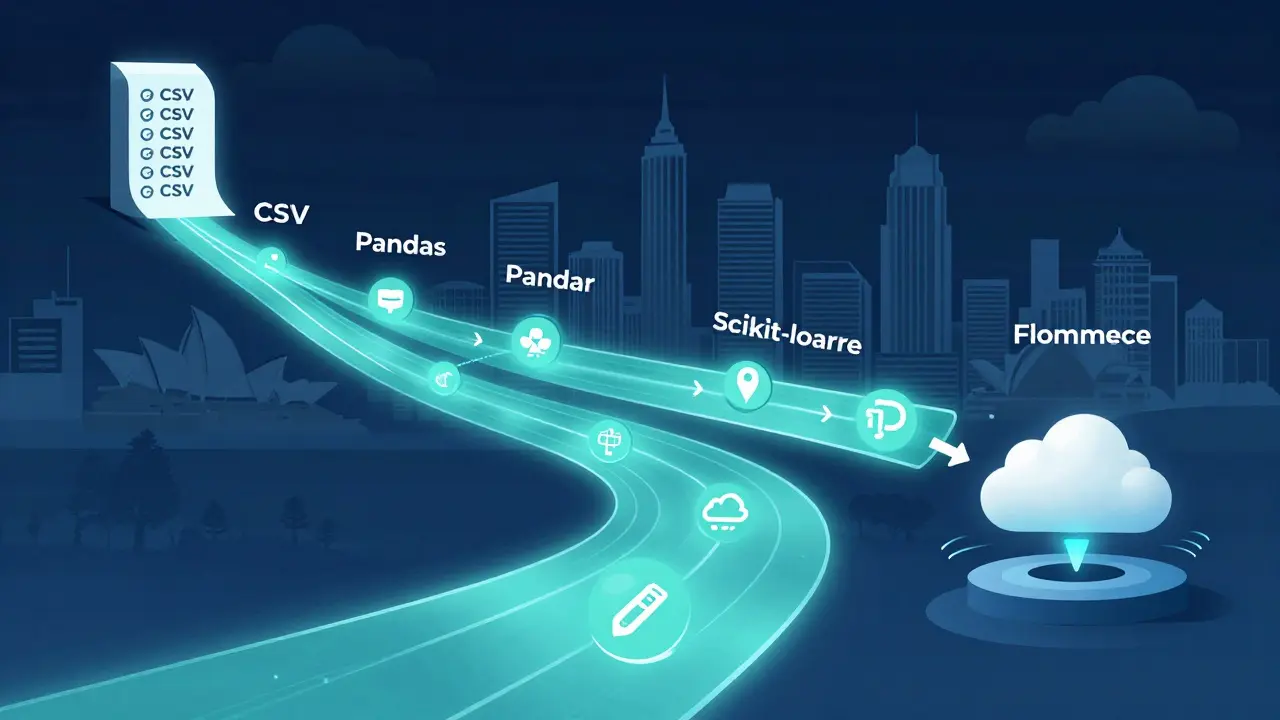
Let’s say you want to predict whether a customer will churn. Here’s how a real Python-based AI pipeline looks:
- Load the data with Pandas:
df = pd.read_csv('customers.csv') - Clean it: Drop missing values, encode categories, scale features. Pandas and Scikit-learn make this a few lines of code.
- Split it: Use
train_test_splitfrom Scikit-learn to separate training and testing data. - Choose a model: Start with a simple logistic regression. If it performs poorly, try a random forest.
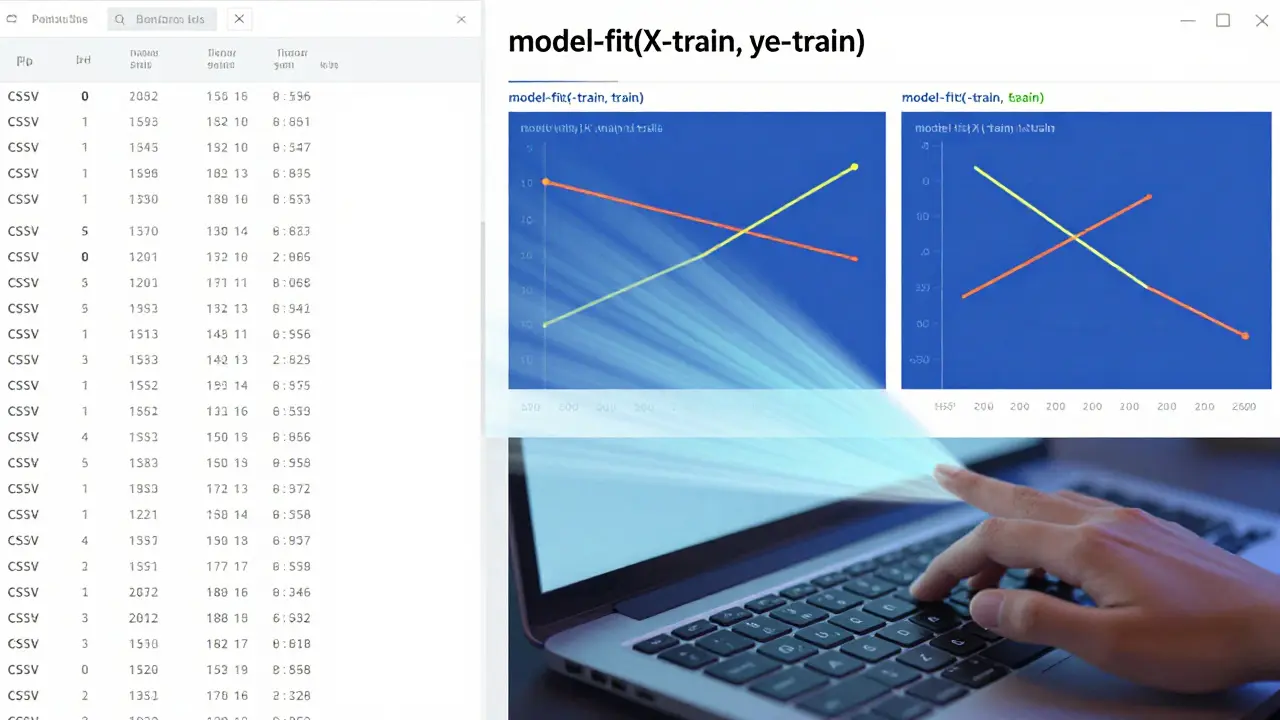
- Train it: One line:
model.fit(X_train, y_train) - Test it:
accuracy = model.score(X_test, y_test) - Deploy it: Save the model with
pickleorjoblib, then plug it into a web API using Flask or FastAPI.
You don’t need a cloud server or a GPU cluster to start. A laptop with 8GB of RAM is enough. I’ve trained models on older MacBooks in coffee shops. It works.
Deep Learning? Start Simple
When people hear "AI," they think of ChatGPT or self-driving cars. That’s deep learning. But deep learning isn’t always the answer. Most business problems don’t need neural networks with millions of parameters. They need clear patterns from structured data. That’s where Scikit-learn shines.
Here’s the truth: 70% of AI projects in small to medium businesses never move past traditional machine learning. Why? Because deep learning requires huge datasets, lots of computing power, and deep expertise. Python makes deep learning accessible, but it doesn’t mean you should use it for everything.
Try this: Use Scikit-learn first. Get a model that works. Then ask: "Can I improve this with a neural network?" If the answer is yes, then bring in PyTorch. If not, you’ve saved weeks of work.
Common Mistakes (and How to Avoid Them)
Python is forgiving. That’s why so many people fail with it.
- Skipping data cleaning - Garbage in, garbage out. Always check for missing values, outliers, and duplicates.
- Using the wrong metric - Accuracy isn’t everything. If 95% of your data is one class, accuracy is meaningless. Use precision, recall, or F1-score.
- Overfitting - Your model memorizes the training data instead of learning patterns. Use cross-validation and regularization.
- Ignoring version control - Use Git. Even if you’re alone. You’ll thank yourself when you accidentally delete a working version.
- Trying to learn everything at once - Don’t jump into transformers and LLMs on day one. Master NumPy, Pandas, and Scikit-learn first.
One developer I know spent six months building a neural network for fraud detection. It was accurate, but took 12 hours to train. He switched to a random forest. It ran in 12 minutes. Accuracy was 98.3%. He kept the neural network as a backup. Sometimes, simpler is smarter.
What Comes Next? Beyond the Basics
Once you’re comfortable with the core stack, here’s where to go:
- MLflow - Track your experiments. Save models, parameters, and results. No more "which version worked?"
- Streamlit - Turn your model into a web app in under an hour. No HTML, no CSS. Just Python.
- Hugging Face - Use pre-trained models for text, images, and audio. Fine-tune them with your data.
- ONNX - Export models to run on edge devices or in production environments.
These aren’t just tools. They’re bridges. From prototype to product. From your laptop to your client’s server.
Real Impact, Not Just Code
Python for AI isn’t about writing clever code. It’s about solving problems. A hospital in Sydney used Python to predict sepsis risk 6 hours earlier than traditional methods. A farm in Victoria used it to optimize irrigation using soil sensor data. A small e-commerce store cut customer support costs by 40% using a chatbot built with Python and Hugging Face.
You don’t need to be a genius. You don’t need a PhD. You need to start. One dataset. One model. One week. That’s how it begins.
Do I need to know advanced math to use Python for AI?
No. You don’t need to derive backpropagation equations by hand. Libraries like TensorFlow and PyTorch handle the math automatically. What you do need is a basic understanding of concepts like training data, overfitting, and evaluation metrics. Most people learn these by doing, not by studying textbooks.
Is Python the only language for AI?
No, but it’s the most practical. R, Julia, and even Java have AI libraries. But none have Python’s ecosystem. The tools, tutorials, Stack Overflow answers, and pre-trained models are all built around Python. If you’re starting out, Python gives you the fastest path to results.
Can I use Python for AI without a GPU?
Absolutely. Most machine learning models (like random forests or logistic regression) run fine on a CPU. Even deep learning models can be trained on CPU for small datasets. You only need a GPU if you’re working with massive images, video, or language models with billions of parameters. Start with what you have.
How long does it take to get good at Python for AI?
You can build your first working model in a weekend. Get comfortable with the basics in two to three weeks. Become confident enough to solve real problems in three to six months. It’s not about memorizing everything-it’s about building, failing, and trying again.
What’s the best way to learn Python for AI?
Work on a problem you care about. Predict your own sleep patterns. Classify your music playlists. Detect spam in your emails. Use real data. Follow tutorials, yes-but build your own version. That’s how skills stick. The best learners aren’t the ones who watch the most videos. They’re the ones who broke their code five times and fixed it each time.
Final Thought: Start Small, Think Big
Python for AI isn’t a destination. It’s a habit. Open your notebook. Load a dataset. Run one line of code. See what happens. The first model you build might be terrible. But it’s yours. And that’s how every expert started.