

Artificial intelligence is no longer a futuristic concept reserved for tech giants. In 2026, it’s a practical tool that small businesses and enterprises alike use to solve real problems. If you’re looking to boost your business, you don’t need to replace your entire workforce with robots. You need smart, actionable strategies that integrate AI into your existing workflows without disrupting them.
The biggest mistake companies make is treating AI as a magic wand. It isn’t. It’s a lever. Pull it correctly, and you multiply your output. Pull it wrong, and you waste money on tools that sit unused. This guide cuts through the hype and gives you specific, high-impact ways to deploy AI right now.
Start with Automation, Not Creation
Most people think of AI and immediately picture chatbots writing copy or generating images. While those are useful, they are not where you’ll find the quickest return on investment. Start with boring, repetitive tasks.
Look at your daily operations. Where do employees spend hours doing the same thing? Data entry, invoice processing, scheduling meetings, or sorting customer emails. These are prime candidates for RPA (Robotic Process Automation) combined with AI-driven decision logic.
- Invoice Processing: Use OCR (Optical Character Recognition) tools to extract data from PDF invoices and auto-populate your accounting software. This reduces manual entry errors by nearly 100%.
- Email Triage: Deploy an AI assistant that categorizes incoming emails by urgency and topic. It can draft responses for routine queries, leaving your team to handle complex issues.
- Scheduling: Let an AI agent manage calendars, find meeting slots, and send reminders. This frees up administrative time for higher-value work.
By automating these low-value tasks first, you build confidence in AI within your organization. You prove it works before asking anyone to trust it with creative or strategic decisions.
Leverage Generative AI for Content at Scale
Once you’ve automated the grunt work, turn to content creation. Generative AI models have become incredibly sophisticated. They can help you produce drafts, social media posts, and marketing copy in minutes rather than hours.
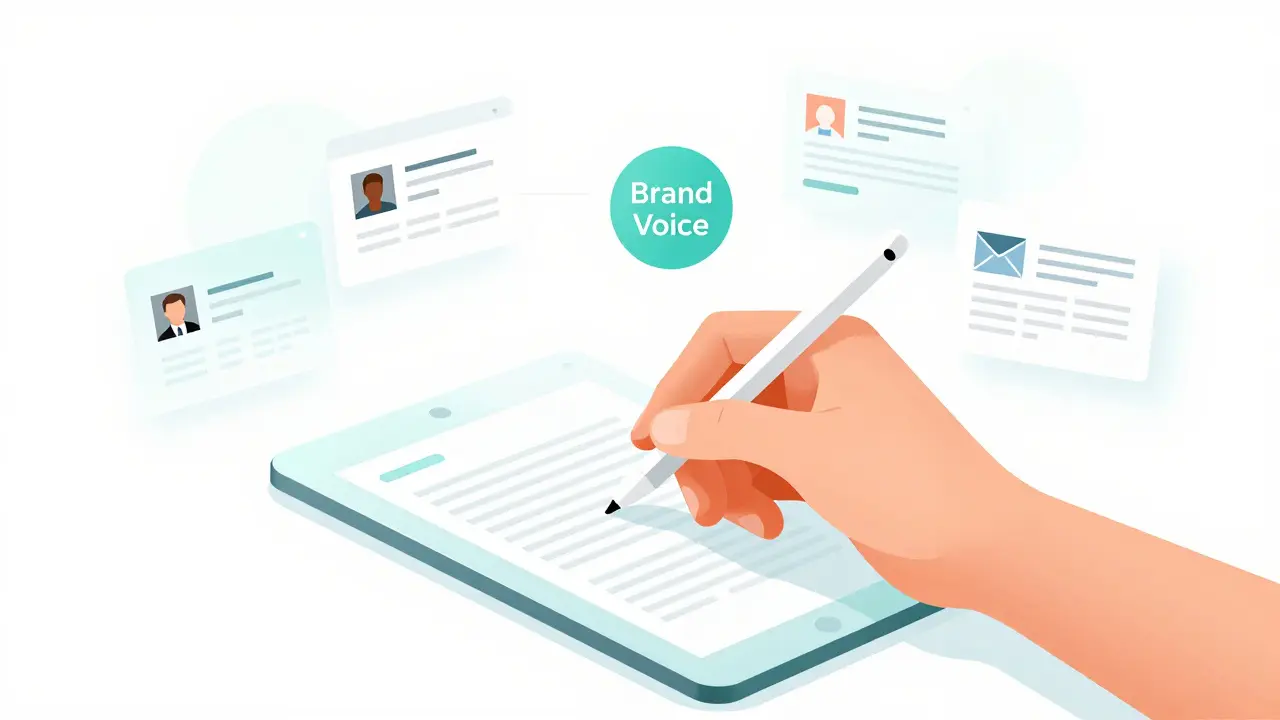
However, there’s a catch: AI lacks context. It doesn’t know your brand voice unless you teach it. Here’s how to do it right:
- Create a Brand Voice Guide: Document your tone, preferred vocabulary, and style rules. Feed this document into your AI tool’s custom instructions.
- Use the “Draft-Edit-Publish” Model: Never publish raw AI output. Have a human editor review every piece for accuracy, tone, and factual correctness.
- Repurpose Content: Turn one blog post into ten social media updates, three email newsletters, and a LinkedIn article using AI summarization tools.
This approach scales your content output without sacrificing quality. It also keeps your team engaged in the creative process rather than making them feel replaced.
Enhance Customer Experience with Personalization
Customers expect personalized experiences. They want recommendations that match their interests and support that understands their history. AI makes this possible at scale.
Implement Recommendation Engines that analyze past purchase behavior to suggest relevant products. If you run an e-commerce store, this can increase average order value by 15-30%. For service businesses, use AI to predict when a client might need follow-up based on usage patterns.
Also, consider deploying Conversational AI for customer support. Unlike old-school chatbots, modern models can understand nuance and context. They can resolve common issues instantly and escalate complex ones to human agents with full conversation history.
The key is transparency. Tell customers when they’re talking to an AI. Most people appreciate the speed but value knowing they can reach a human if needed.
Make Data-Driven Decisions with Predictive Analytics
Intuition is great, but data is better. AI excels at finding patterns in large datasets that humans miss. Use predictive analytics to forecast sales, inventory needs, and market trends.
For example, retail businesses can use AI to predict seasonal demand spikes and adjust inventory accordingly. This prevents stockouts during peak times and reduces holding costs during slow periods. Manufacturing firms can use predictive maintenance algorithms to anticipate equipment failures before they happen, minimizing downtime.
To get started, ensure your data is clean and centralized. AI models are only as good as the data they’re trained on. Invest in a robust data warehouse or cloud-based analytics platform if you haven’t already.
Prioritize Data Privacy and Security
As you integrate more AI tools, you collect and process more data. This brings significant privacy and security risks. In 2026, regulations like GDPR and CCPA are strictly enforced, and penalties for non-compliance are severe.
Take these steps to protect your business:
- Audit Your Data Flows: Map out where customer data goes when you use third-party AI tools. Ensure vendors comply with privacy laws.
- Anonymize Data: Remove personally identifiable information (PII) before feeding data into AI models for training or analysis.
- Encrypt Everything: Use end-to-end encryption for data in transit and at rest. This protects against breaches even if systems are compromised.
- Train Employees: Teach staff how to recognize phishing attempts and social engineering attacks targeting AI systems.
Security isn’t just an IT issue; it’s a business imperative. One breach can destroy years of reputation building overnight.

Measure ROI and Iterate Continuously
Don’t implement AI for the sake of it. Track metrics to see if it’s actually helping your business. Define clear KPIs for each initiative:
| Initiative | Primary Metric | Secondary Metric |
|---|---|---|
| Automation | Time Saved per Task | Error Rate Reduction |
| Content Generation | Content Output Volume | Engagement Rate |
| Customer Support | Resolution Time | Customer Satisfaction Score (CSAT) |
| Predictive Analytics | Forecast Accuracy | Inventory Turnover Ratio |
Review these metrics monthly. If an AI tool isn’t delivering value, pause its use, retrain it, or replace it. AI evolves rapidly, so what works today may be obsolete next year. Stay agile and keep testing new solutions.
Build an AI-Savvy Culture
Technology alone won’t transform your business. People will. Encourage your team to experiment with AI tools. Host workshops, share success stories, and reward innovation.
Address fears openly. Many employees worry AI will take their jobs. Reassure them that AI is designed to augment human capabilities, not replace them. Show them how AI handles tedious tasks so they can focus on creative, strategic, and interpersonal work-the things humans do best.
Finally, stay curious. Follow industry news, join online communities, and attend webinars. The AI landscape changes fast, and continuous learning is essential to staying competitive.
How much does it cost to implement AI in a small business?
Costs vary widely depending on the scope. Basic SaaS tools for automation or content generation can start at $20-$50 per month. More advanced solutions like custom predictive models or integrated CRM AI may cost thousands upfront plus ongoing maintenance fees. Start small with off-the-shelf tools and scale as you see ROI.
Is my data safe when I use AI tools?
It depends on the vendor. Reputable providers offer enterprise-grade security and compliance certifications. Always read the terms of service and privacy policy. Avoid uploading sensitive or proprietary data into public AI models. Use private instances or anonymized datasets whenever possible.
Do I need to hire data scientists to use AI?
Not necessarily. Many modern AI platforms are user-friendly and require no coding skills. You can set up chatbots, automate workflows, and generate content with minimal technical knowledge. However, for complex projects like building custom recommendation engines, you may need specialized expertise.
What are the biggest risks of adopting AI?
The main risks include bias in AI outputs, data privacy violations, over-reliance on automation leading to skill degradation, and security vulnerabilities. Mitigate these by auditing algorithms regularly, enforcing strict data governance, maintaining human oversight, and investing in cybersecurity.
How quickly can I expect to see results from AI initiatives?
Simple automations and content generation tools can show immediate benefits within weeks. More complex implementations like predictive analytics or personalized recommendation systems may take months to optimize and deliver measurable ROI. Patience and iterative improvement are key.