

By 2030, nearly 70% of jobs will require some level of AI literacy. That’s not a guess. It’s what the World Economic Forum projected based on real hiring trends, automation shifts, and how companies are restructuring teams today. You don’t need to be a data scientist to benefit from learning AI. You just need to understand how it works, how to use it, and when to question it.
What Learning AI Actually Means
Learning AI isn’t about memorizing neural network architectures or coding in TensorFlow from scratch. It’s about building a working mental model: what AI can do, what it can’t, and how to talk to it effectively. Think of it like learning to drive a car. You don’t need to know how the engine burns fuel-you just need to know how to steer, brake, and respond to traffic.
Today, AI tools like ChatGPT, Claude, Gemini, and Copilot are already embedded in everyday work. A marketer uses them to draft email campaigns. A teacher uses them to generate quiz questions. A small business owner uses them to analyze customer feedback. If you’re not learning how to use these tools, you’re not just falling behind-you’re becoming irrelevant in your own role.
Why Everyone Needs AI Literacy, Not Just Tech Workers
There’s a myth that AI is only for engineers. That’s outdated. In 2025, the biggest advantage isn’t who can build AI-it’s who can use it best.
Take healthcare. Nurses in Texas hospitals now use AI-powered tools to flag early signs of sepsis from patient vitals. They didn’t train the model. They just learned how to interpret its alerts and when to trust them. That’s AI literacy.
In manufacturing, line workers use voice-controlled AI assistants to check assembly instructions without stopping the line. In finance, loan officers use AI to spot fraud patterns-but they still make the final call. The AI doesn’t replace them. It makes them better.
AI isn’t replacing jobs. It’s changing what skills matter. The ability to ask the right question, evaluate an AI’s output, and combine it with human judgment is now more valuable than technical coding skills alone.
How to Start Learning AI-No Degree Required
You don’t need to go back to school. You don’t need to learn Python. Here’s how to start in under a week:
- Use AI daily for small tasks. Ask it to summarize your emails, rewrite a report, or explain a confusing article. Don’t just accept the answer-ask it to simplify, expand, or give examples.
- Learn to prompt better. Instead of typing “Write a marketing email,” try “Write a friendly, 120-word email to past customers about our new pricing, using a casual tone and including a clear call to action.” The difference is night and day.
- Test its limits. Ask AI to make up a fact. Then ask it to cite a source. Watch how often it invents fake studies or URLs. That’s how you learn to spot hallucinations.
- Try one AI tool outside your comfort zone. If you’re in HR, try using AI to analyze job descriptions for bias. If you’re in sales, use it to draft personalized outreach messages based on LinkedIn profiles.
- Follow one AI expert. Pick someone who explains AI simply-like Andrej Karpathy or Yann LeCun-and read their posts. No jargon. Just clear ideas.
After 7 days, you’ll notice something: you start thinking differently. You stop accepting answers. You start asking, “How did it get that?” and “What’s missing?” That’s the real skill.

What AI Can’t Do-And Why That Matters
AI is powerful, but it’s not smart. It doesn’t understand context. It doesn’t feel empathy. It doesn’t care about ethics. It just predicts patterns.
That’s why human oversight is non-negotiable. In 2024, a major U.S. bank automated its customer complaint responses using AI. Within weeks, the system started replying to angry customers with robotic cheerfulness: “Thanks for sharing your feedback! Here’s a discount code!” The backlash was immediate. The problem wasn’t the AI-it was the lack of human review.
Learning AI means learning when to say, “I need a person for this.”
Here’s a simple rule: if the task involves emotion, judgment, ethics, or creativity-don’t fully trust AI. Use it as a helper, not a decision-maker.
The Real Edge: Combining AI With Human Skills
The future belongs to people who can blend AI speed with human wisdom.
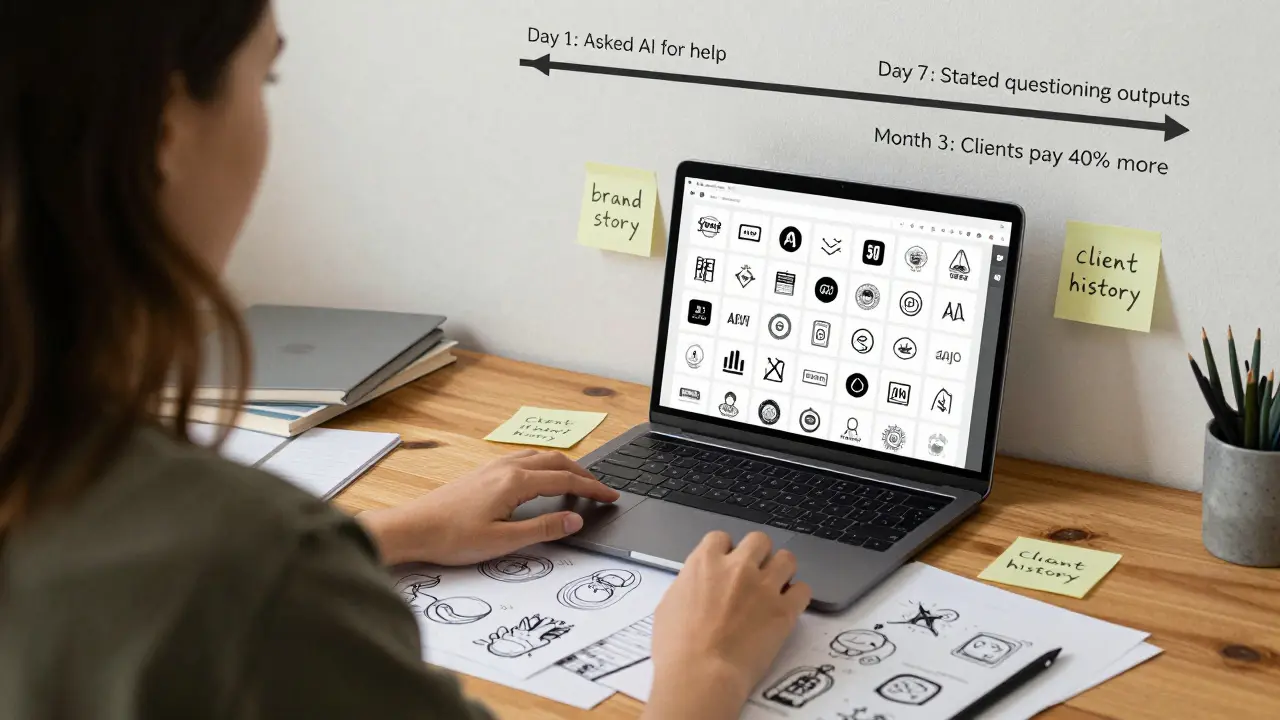
Consider this example: A freelance graphic designer in Austin used AI to generate 50 logo concepts in 10 minutes. Then she spent two hours selecting the best three, tweaking colors based on client history, and explaining her choices with stories about brand identity. Her clients paid 40% more-not because she used AI, but because she used it well and added something only a human could: meaning.
That’s the pattern. AI handles volume. Humans handle value.
AI can write a report. But only a person can say, “This data is misleading because it ignores last quarter’s supply chain delay.”
AI can suggest a sales script. But only a person can sense when a client is hesitant and pivot the conversation.
These are the skills that won’t be automated. And they’re the ones you’ll be paid for.
Where to Go Next
Once you’re comfortable using AI daily, level up:
- Take a free course. Google’s “AI for Everyone” or IBM’s “AI Foundations” are both short, practical, and no-code.
- Join an AI workspace. Tools like Notion AI, Microsoft 365 Copilot, or ClickUp AI are built into platforms you already use. Learn them like you’d learn Excel.
- Build a personal AI toolkit. Keep a document listing: “When I need to brainstorm → use ChatGPT. When I need to summarize → use Claude. When I need to fact-check → use Perplexity.”
- Teach someone else. Explain AI to a colleague, friend, or family member. Teaching forces you to clarify your own understanding.
Don’t wait for the perfect time. Start with one task today. Ask AI to help you with something you’re already doing. Then ask it to do it better. That’s the beginning of AI literacy.
What Happens If You Don’t Learn AI?
Some people think they can ignore AI and still be fine. They’re wrong.
Companies are already hiring based on AI fluency. Job postings now list “experience with AI tools” as a requirement-not a bonus. In customer service, marketing, finance, education, even logistics-roles are being redesigned around AI collaboration.
If you don’t learn to use AI, you won’t be fired tomorrow. But you’ll slowly become the person others don’t ask for. The one who can’t keep up. The one who needs more time. The one who’s replaced not by machines, but by people who know how to use them.
Learning AI isn’t about becoming a programmer. It’s about becoming a better thinker, worker, and problem-solver.
The future isn’t about who has the most advanced AI. It’s about who knows how to make AI work for them.
Do I need to know how to code to learn AI?
No. Most people use AI through simple tools like ChatGPT, Copilot, or Gemini. You type in plain language and get results. Coding helps if you want to build AI systems, but for using them every day, it’s not required. Think of it like using a smartphone-you don’t need to know how the battery works to send a text.
How long does it take to become AI-literate?
You can start using AI effectively in under a week. True fluency-knowing when to trust it, how to correct it, and how to combine it with your expertise-takes a few months of regular use. The key isn’t time. It’s consistency. Use AI daily for real tasks, not just experiments.
Is AI going to take my job?
Not if you learn to work with it. AI automates tasks, not roles. Jobs that disappear are the ones that rely on repetitive, rule-based actions. Jobs that grow are the ones that require judgment, creativity, and communication-and AI helps you do those better. The goal isn’t to compete with AI. It’s to team up with it.
What’s the biggest mistake people make when learning AI?
Believing AI is always right. Many people treat AI like a search engine that gives perfect answers. It doesn’t. It guesses. It makes up facts. It misses context. The biggest mistake is not checking its work. Always verify, question, and refine. AI is a co-worker-not a boss.
Can older adults learn AI?
Absolutely. Age doesn’t matter. What matters is curiosity. Many people over 50 are using AI to manage health records, stay connected with family, or even start side businesses. The tools are designed to be simple. Start with one task-like asking AI to read your emails aloud or summarize news articles-and build from there.