
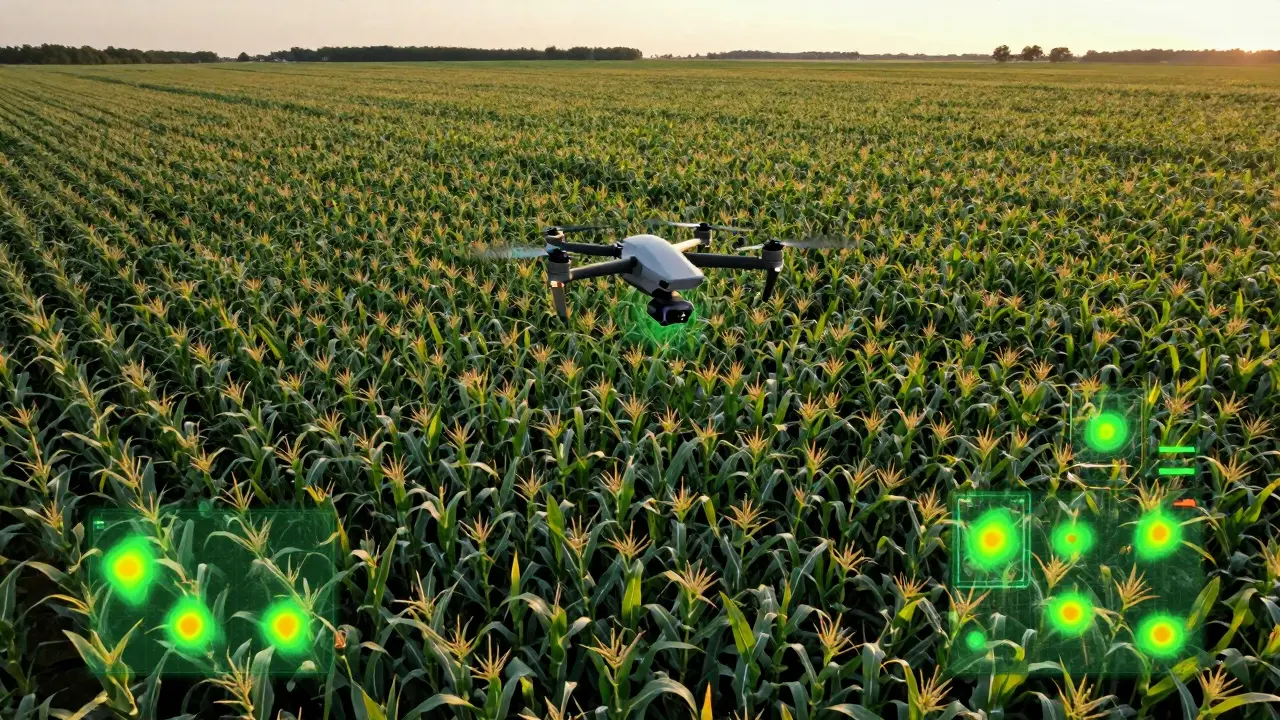
Every year, farmers around the world face the same impossible choices: too little rain, rising costs, labor shortages, and unpredictable markets. But in 2026, something has changed. Across fields in Iowa, Punjab, and Kent, machines are now making decisions that used to take hours of human judgment-and they’re doing it better. Artificial intelligence isn’t just a buzzword in agriculture anymore. It’s the quiet force behind the most efficient farms on the planet.
AI Sees What Human Eyes Can’t
Imagine standing in a 500-acre cornfield at dawn. You squint at the rows, trying to spot the first signs of disease. One sick plant out of 200,000 could mean a $50,000 loss. Now, imagine a drone flying overhead, snapping 5,000 high-res images in 10 minutes. An AI model analyzes each pixel, comparing it to a database of 12 million labeled crop images. It finds the exact spot where a fungal infection is starting-even before the leaves turn yellow.
This isn’t science fiction. Companies like Blue River Technology and Granular use computer vision powered by deep learning to detect pests, nutrient deficiencies, and water stress with 94% accuracy. In Brazil, soybean farmers using AI-driven imaging cut pesticide use by 30% in just one season. The system doesn’t just tell them something’s wrong-it tells them exactly where to spray, and how much.
Robots That Work 24/7, Without Coffee Breaks
There’s a labor crisis in farming. In the U.S., the average age of a farmer is 58. Young people aren’t replacing them fast enough. In Europe, seasonal workers are harder to find after Brexit and pandemic disruptions. Enter ag robots.
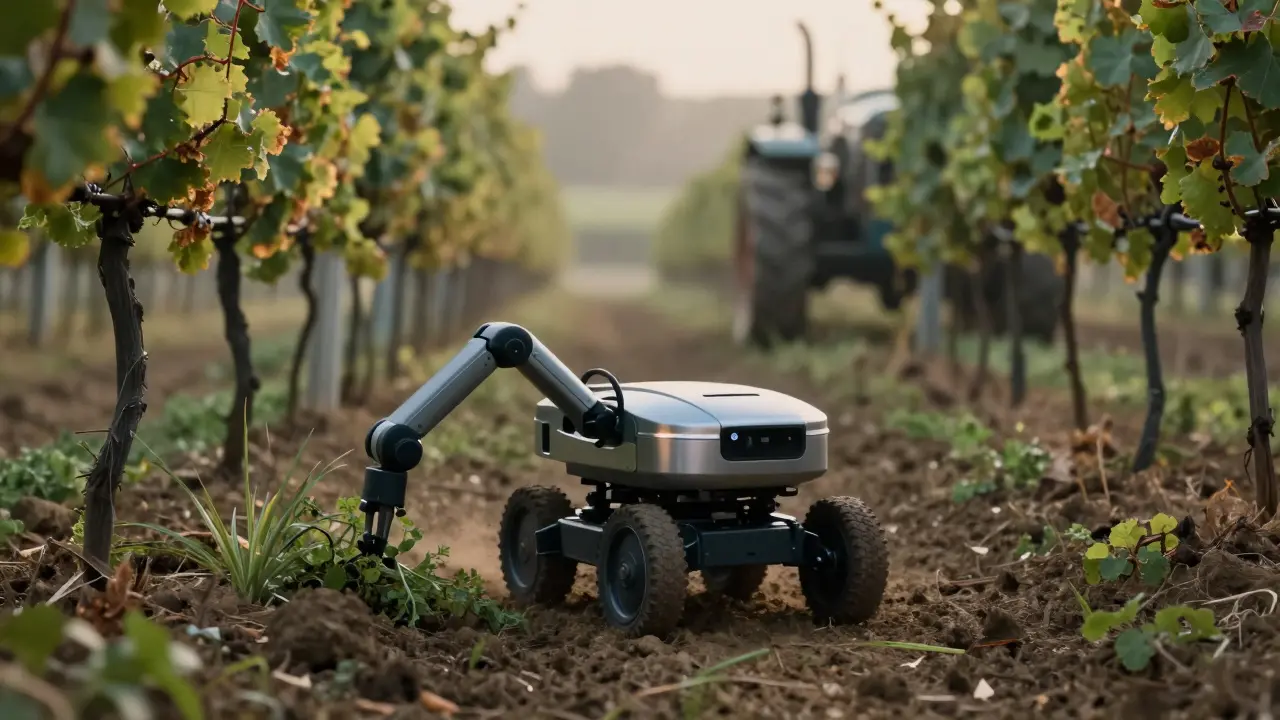
Robots like the FarmWise Talos or the Naïo Technologies Oz aren’t just moving parts. They’re AI-powered field hands. Equipped with sensors, GPS, and real-time decision engines, they can weed between rows with millimeter precision. They don’t need sleep. They don’t get tired. And they cost less than hiring a worker over time.
In France, a vineyard owner switched from manual weeding to AI robots. His labor costs dropped by 60%. His grape yield went up because weeds weren’t stealing nutrients anymore. And the soil? Less compacted. No heavy tractors driving over the same paths day after day.
Predicting the Weather, But for Crops
Weather forecasts are useful-but they’re not enough. What farmers need is crop-specific predictions. Will this variety of wheat survive the next heatwave? Will the soil moisture hold until next Tuesday? AI models answer those questions by stitching together satellite data, soil sensors, historical yields, and local climate patterns.
IBM’s Watson Decision Platform for Agriculture processes over 200 variables per acre. It tells farmers when to plant, when to harvest, and even what price they can expect at market. In Kansas, a wheat grower used AI to delay planting by five days based on predicted rainfall. The result? A 22% increase in yield per acre.
These models don’t guess. They learn. Every harvest, every drought, every pest outbreak feeds back into the system. The more data it gets, the smarter it gets. And farms that use this data are now outperforming traditional ones by up to 40% in profitability.
Smart Irrigation That Knows When to Stop
Water waste in agriculture is staggering. Globally, over 60% of freshwater withdrawals go to farming-and much of it’s wasted through over-irrigation.
AI-driven irrigation systems change that. Sensors buried in the soil measure moisture levels every 15 minutes. Weather stations feed in humidity and evaporation rates. AI combines this with plant type, growth stage, and root depth to calculate exactly how much water each patch of land needs.
In California’s Central Valley, where almonds are king, farmers using AI irrigation cut water use by 35% without losing a single pound of crop. The system doesn’t just turn sprinklers on and off. It adjusts drip lines zone by zone. One row gets 2 gallons. The next gets 0.5. It’s like giving each plant its own personalized water plan.
From Reactive to Predictive: The New Farming Mindset
Traditional farming is reactive. You see a bug? Spray. The crop turns brown? Hope for rain. AI flips that script. It’s no longer about fixing problems-it’s about preventing them.
AI tools now predict disease outbreaks weeks in advance. They forecast market prices based on global supply chains and consumer trends. They even recommend which seeds to buy next season based on soil health trends from the past five years.
One study from the University of Illinois tracked 1,200 mid-sized farms over three years. Those using AI tools had 31% fewer crop losses, 28% lower input costs, and 19% higher net income. The biggest gains? Not from fancy machines. From better decisions.
Who’s Left Behind?
Not every farm can afford a $50,000 AI drone or a subscription to a precision farming platform. Smallholders in sub-Saharan Africa or family farms in Eastern Europe still rely on intuition and experience.
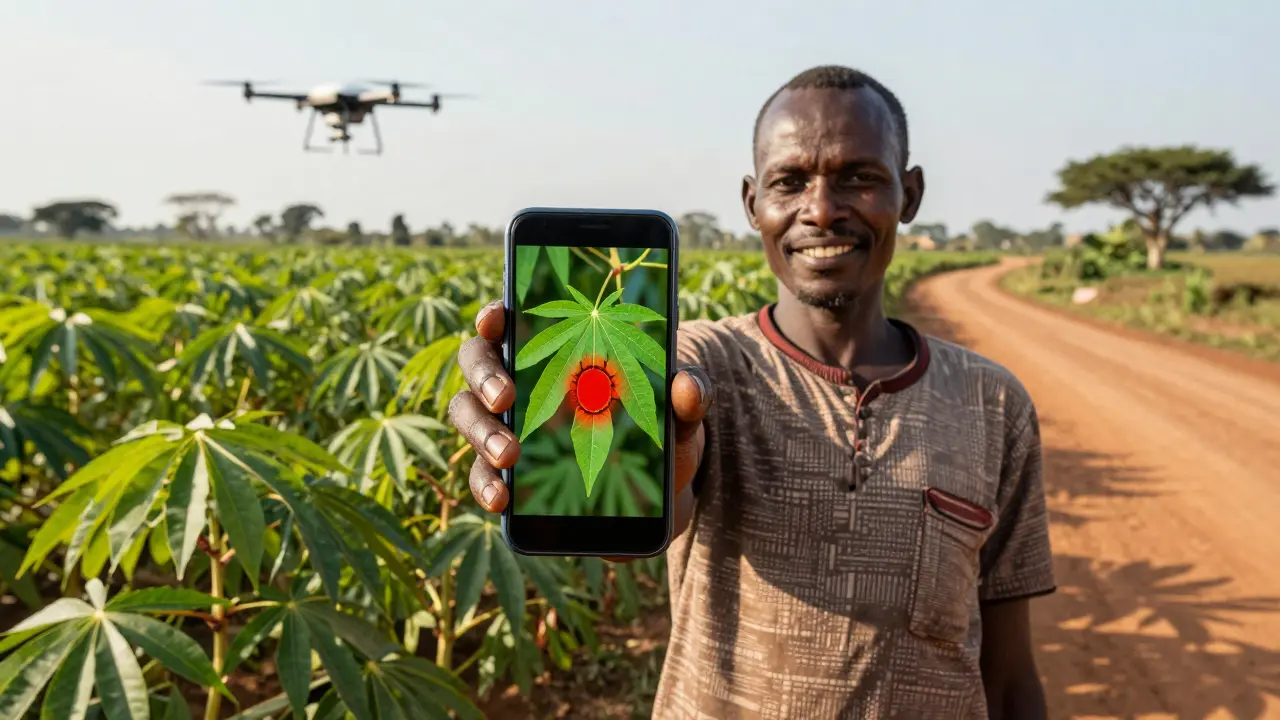
But that’s changing fast. Mobile apps like Plantix and Nuru use smartphone cameras and simple AI to diagnose crop diseases for free. A farmer in Kenya snaps a photo of her cassava leaves. Within seconds, her phone tells her it’s cassava mosaic virus-and how to treat it with locally available pesticides.
Government programs in India and Brazil now subsidize AI tools for small farms. Cooperatives are pooling resources to buy shared drones. The tech isn’t just for big agribusiness anymore. It’s trickling down.
The Future Isn’t Just Faster-It’s Smarter
By 2030, the global AI in agriculture market will be worth over $20 billion. But the real value isn’t in the gadgets. It’s in the shift: from guessing to knowing. From reacting to anticipating. From one-size-fits-all to hyper-localized care.
AI won’t replace farmers. It will empower them. The best farmers today aren’t the ones with the biggest tractors. They’re the ones who listen to data, test ideas quickly, and adapt faster than anyone else.
Next time you eat a tomato, think about this: the flavor, the price, the fact that it didn’t rot on the shelf-it’s not just luck. It’s AI.
How does AI help reduce pesticide use in farming?
AI identifies pests and diseases at the exact location they appear, using drone or satellite imagery. Instead of spraying entire fields, farmers target only the affected areas. This precision reduces chemical use by 25-40% while improving crop health. Systems like Blue River’s See & Spray can distinguish between crops and weeds, applying herbicides only where needed.
Can small farmers afford AI tools?
Yes, increasingly so. While high-end systems cost thousands, free or low-cost mobile apps like Plantix and Nuru use smartphone cameras and cloud-based AI to diagnose crop issues. In India and Kenya, government-backed cooperatives now share drone services among smallholders. Subscription models are also emerging, where farmers pay per acre or per season instead of buying hardware upfront.
What data does AI use to make farming decisions?
AI combines satellite imagery, soil sensors, weather forecasts, historical yield records, crop variety traits, and even global market prices. For example, a system might analyze how a specific wheat strain performed under similar temperature and moisture conditions over the last 10 years, then recommend planting dates and fertilizer amounts tailored to that field.
Is AI in agriculture reliable?
For tasks like disease detection, irrigation scheduling, and yield prediction, AI systems are now more accurate than human experts in controlled settings. Field trials show 90%+ accuracy in identifying crop stress. But reliability depends on data quality. Poor sensors or outdated models can lead to errors. The best results come from farms that regularly update their data and combine AI advice with local knowledge.
Does AI replace farm workers?
It reduces the need for manual labor in repetitive, physically demanding tasks like weeding or harvesting. But it creates new roles: data analysts, drone operators, AI system technicians. Farmers who adopt AI often hire fewer seasonal workers but invest in training their existing team to manage technology. The goal isn’t to eliminate jobs-it’s to make farming more sustainable and less exhausting.