

Remember the last time you opened a box of new toys? Maybe it was a set of building blocks or a plush animal. Now, imagine those same items adapting to your child’s mood, learning their favorite colors, or even teaching them math through play. This isn’t science fiction anymore. In 2026, artificial intelligence has quietly moved from server rooms into our living rooms, fundamentally changing how we design, make, and experience toys.
The toy industry is undergoing a massive shift. Traditional manufacturing relied on static designs and mass production. Today, companies are using generative AI to create unique play experiences that evolve with the user. It’s not just about making plastic cheaper; it’s about creating companions that understand context, emotion, and growth.
From Static Designs to Dynamic Playmates
Gone are the days when a teddy bear was just a stuffed animal. Modern AI-driven toys use sensors, microphones, and cameras to interpret the world around them. A popular example is the rise of interactive plushies equipped with natural language processing (NLP). These toys don’t just record and playback audio like old cassette tapes. They listen, process intent, and respond conversationally.
Consider a scenario where a child asks, “Why is the sky blue?” An older toy might play a pre-recorded answer. An AI-powered toy accesses real-time data, adjusts its explanation based on the child’s age, and follows up with questions to keep the conversation going. This level of engagement requires robust cloud connectivity and edge computing capabilities, ensuring low latency responses without draining battery life.
- Emotional Recognition: Cameras detect facial expressions to adjust tone and interaction style.
- Voice Adaptation: Speech engines mimic the cadence and vocabulary of the child’s peer group.
- Contextual Awareness: GPS and indoor positioning help toys suggest activities relevant to the current location.
Generative AI in Concept Development
Before a toy ever reaches a store shelf, it exists as a digital concept. Historically, this phase involved months of sketching, prototyping, and focus groups. Now, design algorithms can generate thousands of variations in hours. Designers input parameters like target age, material constraints, and educational goals, and the AI outputs viable prototypes.
This speed allows for rapid iteration. If market trends show a surge in interest for eco-friendly materials, AI tools can instantly redesign existing models using sustainable plastics or bamboo composites. Companies like Hasbro and Mattel have integrated these systems to predict which color palettes or character traits will resonate most with Gen Alpha. The result is a product lineup that feels personally curated rather than randomly selected.
Moreover, generative AI helps identify safety hazards before physical production begins. Simulations test stress points, small part detachment risks, and chemical interactions, reducing recall rates significantly. This proactive approach saves millions in potential lawsuits and brand damage.

Smart Factories and Customization at Scale
Manufacturing is another area where AI shines. Traditional assembly lines struggle with customization. Changing molds or reprogramming robots is expensive and time-consuming. However, additive manufacturing, commonly known as 3D printing, combined with AI optimization, changes the game entirely.
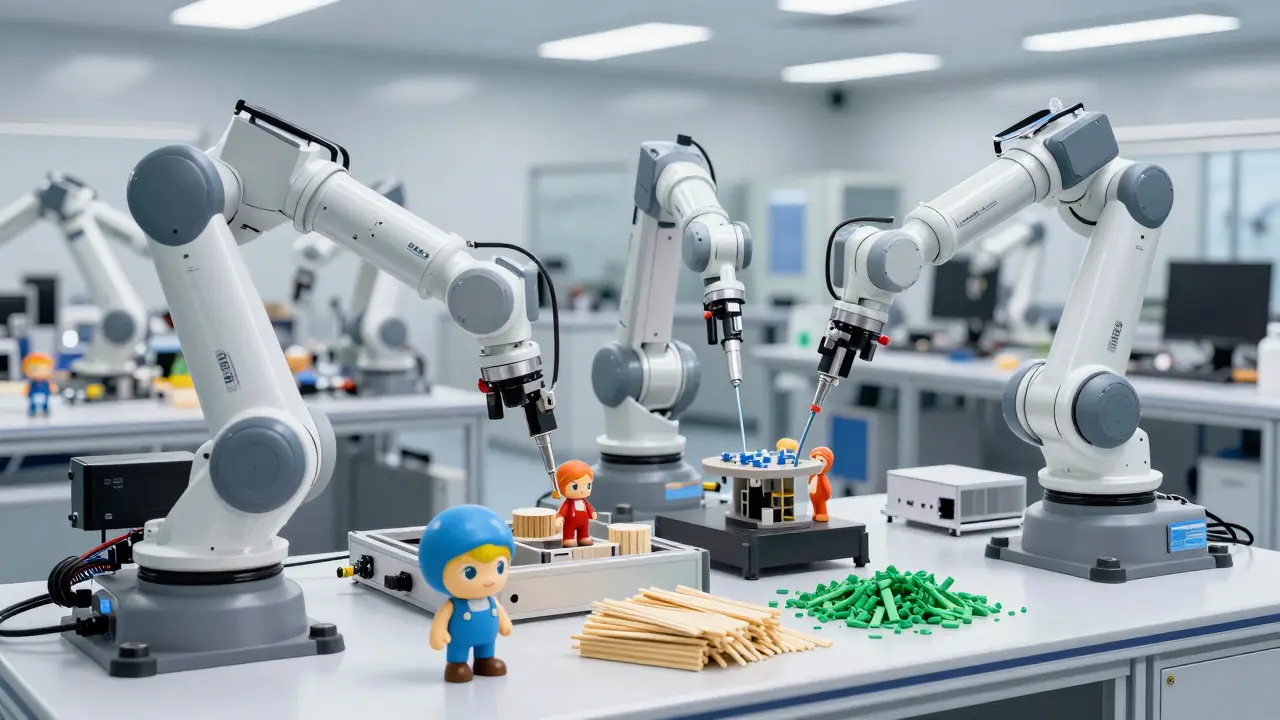
Imagine ordering a action figure online with your child’s name engraved and their specific superhero outfit customized. The order goes directly to a local micro-factory. AI software slices the 3D model optimally to reduce print time and material waste. Robotic arms handle post-processing tasks like sanding and painting with precision exceeding human capability.
| Feature | Traditional Method | AI-Enhanced Method |
|---|---|---|
| Design Cycle | 3-6 Months | 1-2 Weeks |
| Customization Level | Low (Mass Production) | High (Personalized) |
| Material Waste | High (Injection Molding Scrap) | Low (Additive Precision) |
| Inventory Risk | High (Overstock Issues) | Low (On-Demand Printing) |
This shift reduces inventory bloat. Instead of guessing how many units to produce, manufacturers print what is sold. This lean approach minimizes environmental impact by eliminating unsold stock that ends up in landfills.
Educational Value Through Adaptive Learning
Toys have always been educational, but AI makes them truly adaptive. adaptive learning platforms embedded in toys track progress over time. A coding robot, for instance, notices if a child struggles with loops. It doesn’t just repeat the lesson; it breaks the concept down into simpler steps or uses a different analogy.
Parents appreciate this transparency. Many apps connected to these toys provide dashboards showing skills development. You can see exactly how much reading comprehension improved or how problem-solving abilities evolved. This data bridges the gap between playtime and academic performance, giving parents peace of mind that screen-free play is still productive.
Furthermore, AI facilitates inclusive play. Toys can be programmed to support children with disabilities. For visually impaired kids, haptic feedback and audio cues guide construction sets. For non-verbal children, gesture recognition allows interaction without speech. This democratization of play ensures every child can participate fully.
Privacy Concerns and Ethical Considerations
With great power comes great responsibility. Collecting data from children raises significant privacy concerns. Parents worry about who owns their child’s voice recordings or behavioral patterns. In response, regulations like COPPA (Children’s Online Privacy Protection Act) and GDPR-K (General Data Protection Regulation for Children) enforce strict compliance.
Reputable manufacturers now prioritize edge computing. Instead of sending all data to the cloud, processing happens locally on the device. Only anonymized, aggregated insights are shared for improvement purposes. Clear parental controls allow users to delete data histories and disable microphones completely.
Ethical design also means avoiding addictive mechanics. Unlike social media feeds designed to maximize scroll time, AI toys should encourage balanced engagement. Algorithms must recognize when a child needs a break and suggest offline activities. This balance protects mental health while fostering creativity.
The Future Horizon: What’s Next?
We are only scratching the surface. Emerging technologies like augmented reality (AR) glasses paired with AI toys will blend physical and digital worlds seamlessly. Imagine pointing your glasses at a blank wall and seeing a dinosaur roam across it, guided by an AI narrator explaining paleontology facts.
Bio-responsive materials could lead to toys that change texture or temperature based on emotional state. Soft robotics might enable squishy, safe companions that hug back with appropriate pressure. As computing power increases and costs drop, these innovations will become mainstream within the next five years.
Are AI toys safe for young children?
Yes, provided they meet safety standards. Look for certifications like ASTM F963. Ensure the toy uses edge computing to minimize data exposure and has physical parental controls to mute sensors when needed.
Do AI toys replace human interaction?
No, they complement it. AI toys are designed to stimulate curiosity and prepare children for conversations with adults. They act as co-pilots in learning, not replacements for parents or teachers.
How much do AI-enhanced toys cost?
Prices vary widely. Basic interactive plushies start around $30-$50. Advanced coding robots or AR-integrated sets can range from $100 to $300. Subscription fees for content updates may apply, typically $5-$10 per month.
Can I customize my own AI toy?
Some brands offer open APIs for developers, allowing custom behaviors. For general consumers, companion apps let you adjust personality traits, voice accents, and difficulty levels without coding knowledge.
What happens to my child's data?
Check the privacy policy. Reputable companies process data locally and delete personal identifiers after aggregation. Always opt for devices that allow complete data erasure via a physical button or app setting.