

Most people think coding is just for software engineers. But that idea is outdated. In 2026, knowing how to code is less about building apps and more about solving everyday problems efficiently. Whether you are a marketer, a teacher, or a small business owner, coding skills act as a force multiplier. They allow you to automate boring tasks, analyze data without waiting for IT support, and build simple tools that save hours every week.
Why Coding Is No Longer Optional
The modern workplace runs on data. If you cannot read a basic script or understand how an API works, you are limited by what others can do for you. Consider a marketing manager who knows Python. Instead of spending three days manually exporting reports from different platforms, they write a 20-line script to pull data automatically. That is not just efficiency; it is a competitive advantage.
Companies now look for "tech-savvy" candidates in non-technical roles. A financial analyst who understands SQL can query databases directly rather than filing tickets with the data team. This shift means that basic computational thinking is becoming as standard as spreadsheet proficiency was in the 1990s.
The Core Languages You Actually Need
You do not need to learn ten languages. You need two or three that cover most real-world scenarios. Here is where to start:
- Python is a high-level programming language known for its readability and extensive library ecosystem. It is the best starting point because the syntax looks like plain English. Use it for data analysis, automation scripts, and web scraping.
- JavaScript is the scripting language of the web, enabling interactive features on websites. If you work in web development or frontend design, this is non-negotiable. Even backend developers use it via Node.js.
- SQL is a domain-specific language used for managing and querying relational databases. It is not a general-purpose language but essential for anyone who touches data. Learning SELECT, JOIN, and GROUP BY takes only a few weeks.
| Language | Primary Use Case | Learning Curve | Best For |
|---|---|---|---|
| Python | Data Analysis, Automation | Low | Marketers, Analysts, Scientists |
| JavaScript | Web Interactivity, Frontend | Medium | Designers, Web Developers |
| SQL | Database Querying | Low | Business Intelligence, Data Roles |
Beyond Syntax: Thinking Like a Programmer
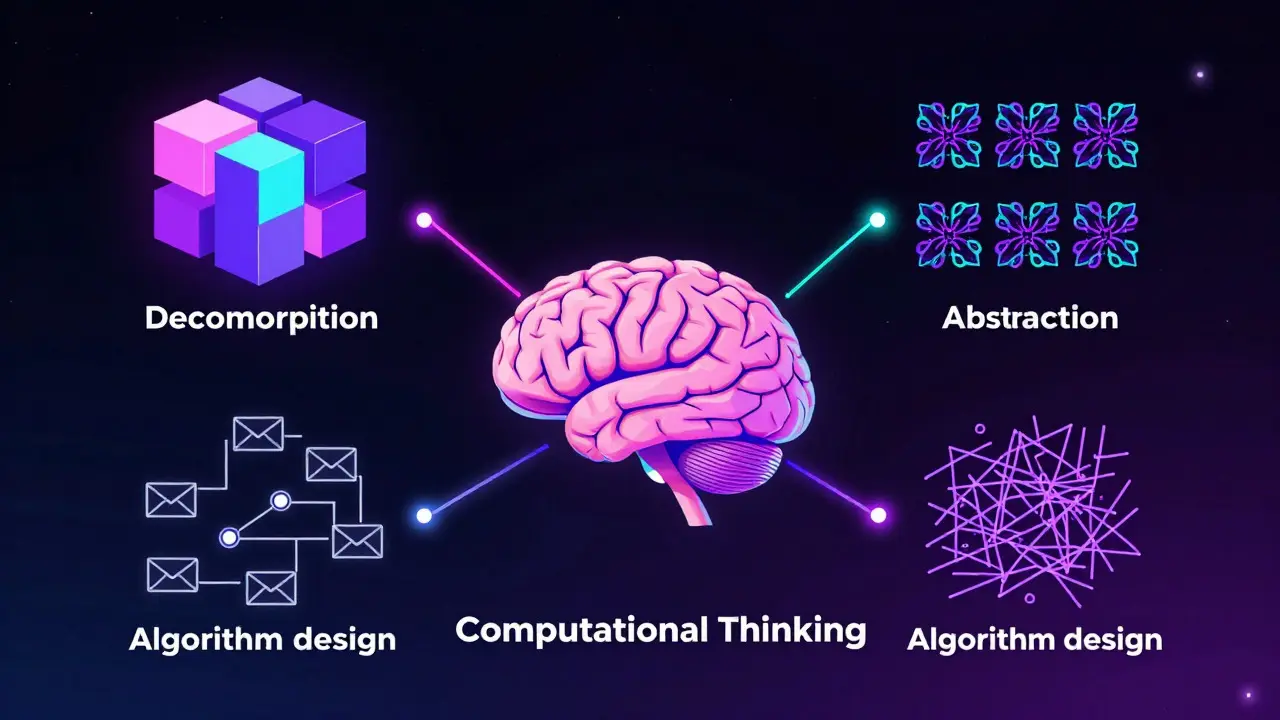
Knowing keywords is useless if you cannot break down a problem. This is called Computational Thinking, which is the process of formulating problems so their solutions can be represented as algorithms. It involves four key steps:
- Decomposition: Breaking a big task into smaller, manageable chunks.
- Pattern Recognition: Identifying similarities between current problems and past ones.
- Abstraction: Focusing on important information while ignoring irrelevant details.
- Algorithm Design: Creating a step-by-step procedure to solve the problem.
For example, if you need to send personalized emails to 5,000 customers, decomposition means separating the list retrieval, message formatting, and sending logic. Pattern recognition helps you realize you did something similar last quarter. Abstraction lets you ignore email server protocols initially. Algorithm design ensures no customer gets two emails.
Practical Applications in Daily Work
Coding skills shine when applied to specific workflows. Here are three concrete examples you can implement immediately:
1. Automating Repetitive Tasks
If you spend time renaming files, moving folders, or copying data between spreadsheets, Python can handle it. Using libraries like Pandas, a data manipulation and analysis library for Python, you can clean messy CSV files in seconds instead of hours. This frees up mental energy for strategic thinking.
2. Building Simple Internal Tools
Many teams rely on clunky Excel macros that break easily. A simple web interface built with Flask, a lightweight web framework for Python, can provide a stable dashboard for tracking inventory or project status. It does not need to be perfect; it just needs to work better than the manual process.
3. Data Visualization
Instead of static charts, use Matplotlib, a plotting library for Python, to create interactive graphs. This allows stakeholders to explore data trends themselves, reducing back-and-forth questions.

How to Learn Without Burning Out
Most people quit coding because they try to learn everything at once. Avoid this trap. Follow this approach:
- Project-Based Learning: Pick one annoying task in your job. Write code to fix it. Ignore best practices initially. Just make it work.
- Daily Micro-Sessions: 20 minutes a day beats 4 hours on Sunday. Consistency builds neural pathways faster than cramming.
- Use Documentation First: Before searching YouTube, read the official docs. They are concise and accurate. Searching for tutorials often leads to outdated methods.
- Join Communities: Platforms like GitHub allow you to see how others solve problems. Reading other people's code is a powerful learning tool.
A common mistake is getting stuck on minor bugs for hours. Set a timer. If you cannot solve it in 15 minutes, ask for help. Stagnation kills motivation.
The Future of Hybrid Skills
The gap between "technical" and "non-technical" jobs is closing. We are seeing the rise of "citizen developers"-people who build software for their own use cases without being professional programmers. As AI tools become more integrated, the ability to prompt and verify code output becomes crucial. You don't need to memorize syntax anymore, but you must understand logic to know if the AI solution is correct.
By mastering basic coding skills, you position yourself as a versatile asset. You are no longer dependent on external resources for simple technical fixes. You gain autonomy, speed, and clarity in your decision-making process.
Do I need to be a math genius to learn coding?
No. Basic arithmetic is sufficient for most practical applications like automation and data analysis. Advanced mathematics is only required for specialized fields like machine learning or game physics.
Which language should I learn first if I have no experience?
Start with Python. Its syntax is readable, and it has a massive community. Once comfortable, add SQL for database access and JavaScript if you plan to work on web interfaces.
Is coding still worth learning with AI tools available?
Yes. AI generates code quickly, but you need coding knowledge to verify correctness, debug errors, and integrate solutions into existing systems. Understanding logic allows you to direct AI effectively.
How much time does it take to become proficient?
Basic proficiency for automating daily tasks takes 3-6 months of consistent part-time study (20-30 minutes daily). Full-stack development requires 1-2 years of dedicated practice.
What is the difference between programming and coding?
Coding refers to writing the actual lines of syntax. Programming includes the broader process of designing logic, debugging, testing, and maintaining the software. Professional roles require both, but beginners often start with coding basics.